
ERP System in India: A Technical & Strategic Guide for Integrated Business Operations (2026)
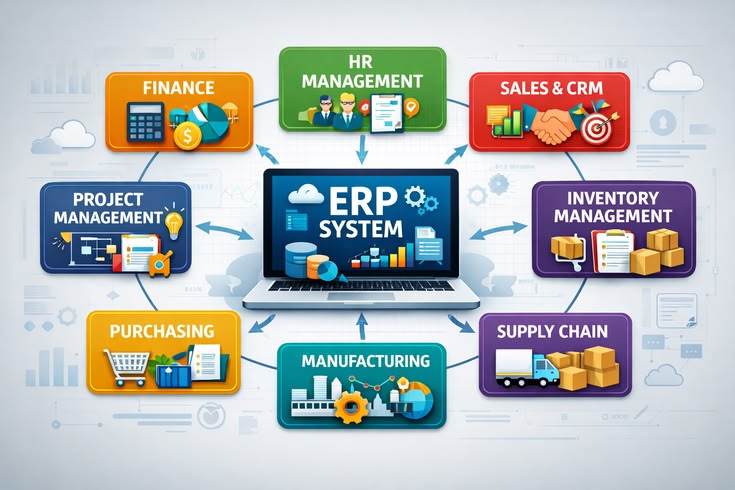
As businesses scale, operational complexity increases across departments finance, inventory, HR, sales, procurement, and compliance. Managing these functions through disconnected tools creates inefficiencies, data silos, and decision delays. This is where an erp system becomes a foundational layer for business operations.
In rapidly growing ecosystems like Pune, Mumbai, and across India, companies are adopting ERP not just for automation, but for real-time operational control and decision intelligence. However, many organizations still misunderstand ERP as a software purchase rather than an enterprise transformation.
This guide explains ERP from a technical architecture and business integration perspective, helping organizations implement it correctly.
What Is ERP: Understanding the Core Concept
The erp full form is Enterprise Resource Planning. At its core, ERP is a centralized system that integrates all key business functions into a single platform.
The erp meaning goes beyond software it represents a unified data environment where all departments operate on the same information in real time. The erp system meaning is therefore not just automation, but integration + standardization + visibility.
For example, when a sales order is created, it automatically updates inventory, triggers billing, and reflects in financial records all within one system.
ERP System Architecture: How It Works Technically
A modern erp system is built using modular and layered architecture:
- Core Database Layer
Centralized data repository storing transactions, records, and master data. This ensures a single source of truth across the organization.
- Application Modules
Each module represents a business function:
- Finance & Accounting
- Inventory & Supply Chain
- Human Resources
- Sales & CRM
- Procurement
- Integration Layer (APIs & Middleware)
Connects ERP with external systems such as:
- Payment gateways
- E-commerce platforms
- HRMS tools
- Government compliance systems
- User Interface Layer
Dashboards and reporting systems that provide real-time insights.
This architecture ensures scalability, flexibility, and cross-functional coordination.
Foundational delivery often ties to custom software development for integrations and extensions beyond standard modules.
ERP What Is Its Role in Business Operations
To answer erp what is in practical terms it is the backbone of business operations. ERP ensures that all departments operate in sync, eliminating duplication and manual intervention.
For example, a manufacturing company in Pune can track raw material usage, production output, and financial impact simultaneously. Similarly, a retail business in Mumbai can manage inventory, sales, and customer data through a unified system.
Types of ERP Systems: Choosing the Right Model
ERP systems are broadly categorized into:
- On-Premise ERP – Installed on company servers, offering control but requiring maintenance
- Cloud ERP – Hosted on cloud infrastructure, offering scalability and lower upfront cost
- Hybrid ERP – Combines both approaches
In India, cloud ERP adoption is growing rapidly due to flexibility, cost-efficiency, and remote accessibility.
ERP Implementation Process: A Structured Approach
ERP implementation is not just deployment it is a transformation process. It involves:
- Business process mapping
- Requirement analysis
- System design
- Data migration
- Integration setup
- Testing and deployment
Failure to follow a structured approach leads to cost overruns and system inefficiencies.
Cost and ROI of ERP Systems
ERP implementation cost depends on:
- Business size
- Number of users
- Modules required
- Customization level
- Integration complexity
While initial investment may seem high, ERP delivers long-term ROI through:
- Operational efficiency
- Reduced manual errors
- Faster decision-making
- Improved compliance
For example, an SME in Mumbai reduced operational delays by integrating inventory and finance through ERP.
Real Business Scenarios: ERP in Action
A logistics company in Pune implemented ERP to manage fleet operations, billing, and reporting in one system, improving efficiency and reducing errors.
A manufacturing unit used ERP to track production cycles and inventory in real time, reducing wastage and improving planning accuracy.
In contrast, companies using multiple disconnected tools often struggle with data inconsistencies and delayed decision-making.
Common ERP Implementation Mistakes
Many businesses fail to achieve ERP success due to:
- Lack of clear requirements
- Over-customization
- Poor data migration
- Inadequate user training
- Choosing technology without business alignment
ERP should be treated as a business transformation project, not just IT implementation.
Integration of ERP with Other Systems
ERP works best when integrated with:
- HRMS systems
- CRM platforms
- Accounting tools
- E-commerce platforms
- Compliance systems
This creates a fully connected digital ecosystem. For people data and payroll flows, specialist HRMS implementations often sit alongside ERP programs.
Why Strategic ERP Implementation Matters
ERP implementation impacts every department. Without proper planning, it can disrupt operations instead of improving them.
At Febstone, ERP is approached through:
- Business process analysis
- System architecture planning
- Integration strategy
- Scalability roadmap
This ensures that ERP aligns with long-term business goals.
Tech consulting and digital marketing can support change management, training communications, and post-go-live adoption across teams.
Conclusion
Erp system is not just software it is the foundation of integrated business operations. From improving efficiency to enabling real-time decision-making, ERP plays a critical role in modern organizations.
For startups, SMEs, and enterprises across Pune, Mumbai, and India, implementing ERP strategically can unlock long-term scalability and control.
With Febstone's consulting-led approach, businesses gain a structured, scalable, and future-ready ERP ecosystem.
Get Expert ERP Implementation Support
Email: info@febstone.com
Our experts help you design, implement, and scale ERP systems aligned with your business operations.
FAQ
1. What is ERP system?
An ERP system is software that integrates all business processes into a single platform.
2. What is ERP full form?
ERP stands for Enterprise Resource Planning.
3. What is ERP meaning?
ERP refers to a system that centralizes and manages business data across departments.
4. What is ERP used for?
It is used for managing finance, HR, inventory, and operations in one system.
5. Is ERP suitable for small businesses?
Yes, especially cloud ERP solutions designed for SMEs.